



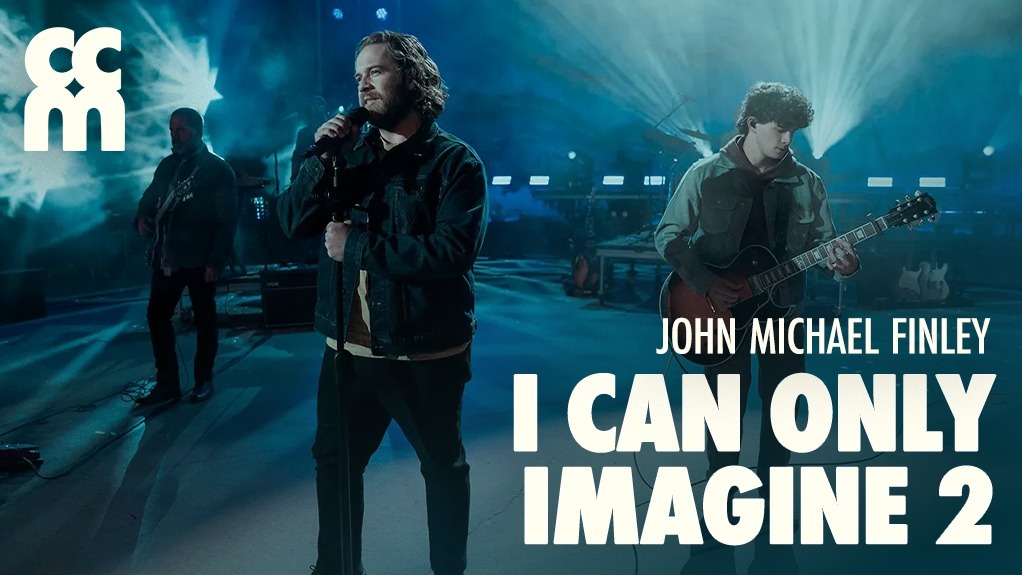
When you think of movie franchises, a true-story rock biopic rarely gets the sequel treatment. Yet that’s exactly the bold move Kingdom Story Company and Lionsgate made when they returned to the world of Bart Millard and MercyMe.
Nearly a decade after the original I Can Only Imagine, we reenter a story that feels both familiar and startlingly different. The first film centered on a young Bart Millard and the wounds left by his father and the push for reconciliation and salvation. This time, the roles are reversed. Bart is now the father, struggling to connect with his son, whose battle with type 1 diabetes has reshaped their household. Their relationship often feels reduced to reminders, restrictions, and medical realities. Love is present, but so is exhaustion.
Into that tension steps singer-songwriter Tim Timmons, portrayed by Milo Ventimiglia. His character brings a steady light into an increasingly heavy narrative. Timmons’ real-life health journey and resilient outlook add warmth and perspective to a Bart who is successful on the outside yet fraying at the edges. The film doesn’t romanticize the pressure. Writing another career-defining hit, staying relevant in the music industry, and trying to be present at home is a collision that comes at a cost.
And once again, Trace Adkins steals scenes as Scott Brickell, MercyMe’s manager, mentor, and part-time farmer. In my conversation with John Michael Finley, we discussed how he intentionally avoided impersonating the real Bart Millard, choosing instead to find the emotional truth of the character. Adkins, however, is almost unfairly good as Brickell. It’s less “performance” and more “did we just roll cameras on the real guy?” And yes, Brickell’s real-life connection to Audio Adrenaline makes its way into the film more than once, which means CCM Magazine readers will absolutely be giving each other knowing glances in the theater.
I’ve followed the trajectory of Kingdom Story Company closely over the years. What they are building deserves attention. Christian music didn’t mature overnight, it evolved. Faith-based filmmaking is similar. There have always been strong entries in the genre, but what Kingdom Story is doing now reflects a growing confidence and craftsmanship. They are shepherding a generation of films that feel more grounded, more textured, and more willing to wrestle with complexity.
I recently sat down with John Michael Finley for an in-depth conversation about the themes of this sequel, the weight of portraying a real person, fatherhood, career longevity, and the personal parallels that made this chapter hit closer to home.

Finley didn’t expect to ever return to Bart Millard’s world. “Absolutely not,” he told me. “We wrapped up the last one like, so nicely. Such a nice little bow we put on it.” But when he read the script, that changed. “As soon as I read the script, I was like, Holy cow, they put it. They put together another incredible project.”
What struck me most in our conversation, and what I felt watching the film, is how personal this chapter became for him. “Spooky, man. It’s spooky,” he said, reflecting on how different his own life is now compared to the first film. “This time around, I’m a father, I’m a husband, have had some life experience… it was, breathtaking, but therapeutic at the same time.”
That honesty bleeds into the film. This Bart is not the underdog kid chasing a dream. He’s the stressed dad, the exhausted frontman, the guy who has tasted success and is still trying to hold it together at home. Finley leaned into that tension. “Let me play the bad cop,” he said about stepping into the heavier side of Bart. “It was such a fun challenge to really step now into this much heavier, much darker world.”
And make no mistake, it is heavier. Finley told me there were cuts of the film that were “too heavy” and had to be trimmed back. “Let’s make something real. Let’s tell a true story. And it’s so real and vulnerable and raw that people are like, oh, I don’t know… I connected with it. Yeah, but I don’t know if I connected with it in a positive way.”
That’s kind of the point.
One of the most compelling parts of our conversation was hearing about early test screenings. “There was a situation where someone stood up and kind of said, you know, I don’t know why Bart’s acting like this… And then another guy stood up and said, I don’t want to argue and disagree, but I feel exactly that way… And ten gentlemen stood up and said, we’re not arguing with you. But like I felt exactly that way.”
That response says more than any marketing campaign could. This is a movie that will hit dads square in the chest.
The film doesn’t shy away from anything. As Finley put it, “We cover everything from cancer to death in the family, to new life in the family, to marital problems, to loss of faith, struggles with faith, parent relationships, type one diabetes.” It is not a carefree cinematic experience. At times it feels like everything that can go wrong does go wrong. But that’s life. And as a filmmaker myself, I appreciate that Kingdom Story had the courage not to sand off all the rough edges.
As a sequel, I Can Only Imagine 2 is a risk. It’s not trying to recreate the emotional high of the first film. It’s asking something harder. It asks you to sit in discomfort for a while. It asks you to look at yourself as a parent, as a spouse, as a person of faith. That won’t be for everyone. Some viewers may walk out feeling a bit wrung out.
But I respect it.
Kingdom Story Company continues to mature as storytellers, and this film feels like a step forward in emotional depth and thematic ambition. It’s heavy. But it’s honest, and that honesty earns it an overall positive review from me.
I Can Only Imagine 2 is in theaters February 20.